
Reimagining existing buildings: unlocking new potential in specialist care environments
At coombes:everitt, our design process can help transform ageing care buildings into uplifting, future-ready spaces. Our Director, John Everitt explains how our creative approach to renovating specialist care buildings reimagines spaces, improves energy performance and empowers the wellbeing of residents and care teams.
Having worked in the specialist care sector for more than a decade, we’ve seen first-hand how care environments continue
to evolve to meet the changing needs of residents. Attitudes towards care have shifted — spaces are now expected to be positive, stimulating and dignified, recognising that the environment plays a central role in supporting wellbeing and independent living.
At the same time, providers are facing a host of new challenges. Advances in adaptive technology provide greater opportunities for independence but these systems need to be integrated properly. Improved survival rates and life
expectancy require specialist environments that can adapt as the occupants grow and age and their care needs change. Sustainability targets and rising energy costs add further demands on already stretched facilities and budgets.
The common theme? Flexible spaces to support these changes. And that’s where much of the existing building stock
falls short.

Many specialist care settings are housed in outdated buildings that may be full of charm and character, but are often constrained by outdated layouts, smaller rooms, limited light, and poor access both internally and to the outdoors. While their heritage may hold value, their design rarely aligns with modern care requirements. These environments struggle to provide the flexibility, accessibility and energy efficiency that both residents and staff now need.
Huge potential can be found when existing buildings are reimagined rather than demolished. With thoughtful design, refurbishment can transform outdated buildings into contemporary, sustainable environments that work harder for residents, families and care teams.
At coombes:everitt, our focus is on unlocking that potential; adapting existing spaces to create supportive, future-proof facilities that meet care needs today and for years to come.
START WITH THE END GOAL IN MIND
When faced with ageing facilities, it can be tempting to focus on short-term fixes. But taking a longer-term view — one guided by your vision for how care will evolve — ensures every investment delivers maximum value.
Our holistic design approach looks at the bigger picture. Through building audits, masterplanning and financial analysis, for example, we explore how the environment can best support both current and future needs. Sometimes, our analysis shows that replacing a building altogether would be more cost effective because of the zero-rate VAT incentive on new buildings. However, if you’re refurbishing accommodation for disabled people, you may be able to claim a reduction in VAT on some of the works necessary to support an individuals care needs.
By aligning refurbishment works with essential maintenance upgrades, we help clients achieve multiple outcomes from one investment by delivering practical, sustainable and uplifting spaces.
We know how disruptive building works can be, so we work with our wider team to minimise disruption so that you can maintain a working environment throughout the build. Building work is often phased to achieve this.
REPURPOSING SPACE TO MEET NEW NEEDS
Good space planning can have a huge impact on how a building is used: repurposing unused areas for learning or therapy, opening up corridors to create communal hubs, or improving circulation spaces to enhance accessibility. In some cases, we’ve created new, inclusive environments without laying a single brick.
At the Kite Centre in Hereford (below), an old NHS building and a 1980s bungalow were repurposed into a fully accessible residential and teaching facility for young adults. Neither building was fit for purpose, so each was reconfigured in phases: the bungalow was gutted first, followed by the main building.


At Meldreth Manor in Cambridgeshire, 1970s accommodation was redesigned to meet today’s expectations of privacy and independence, with ensuite bathrooms replacing shared facilities.
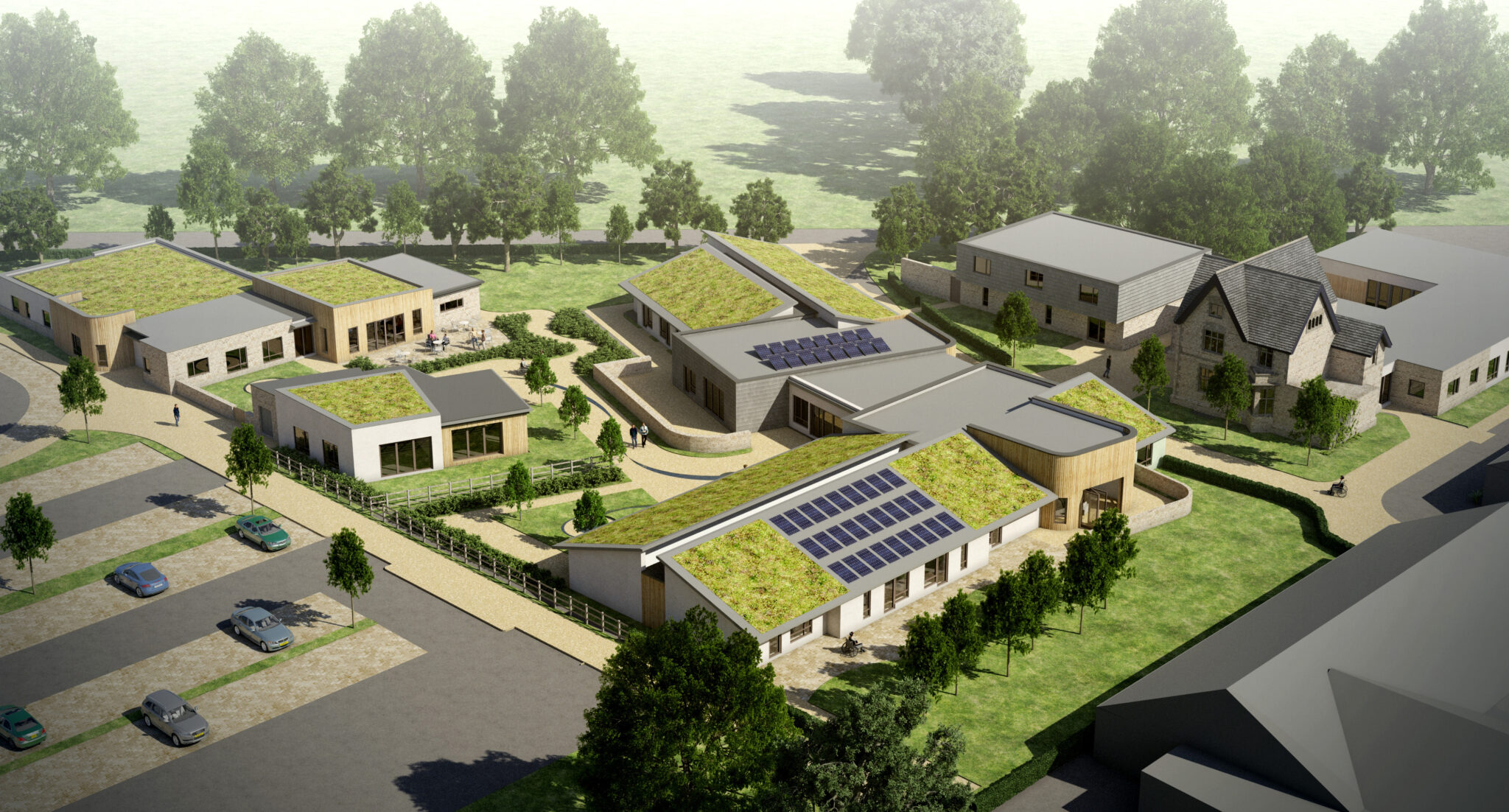
At National Star College’s main site at Ullenwood, we developed a campus-wide masterplan (below) focused on improving student accommodation, day learning and support spaces. The masterplan identified that several existing buildings could be repurposed, reducing the need for new construction. A day student facility was converted into seven fully accessible bedrooms with ensuite wet rooms, while the attic was reimagined to provide essential storage. Every inch of space was considered.
EXTENDING AND ENHANCING EXISTING BUILDINGS
Sometimes, the most effective renovations include a contemporary extension. Alongside reimagining existing space, this can transform how older buildings feel and function by introducing natural light, ventilation and bespoke spaces.
At the Kite Centre, the main building was extended to include a new circulation space with two lifts, three classrooms, two personal care rooms and additional storage. As well as providing additional space in the new extension, the space that was created opened up full access to the first floor of the original building.


IMPROVING SUSTAINABILITY
As well as providing additional space, a carefully placed extension can also improve the energy efficiency of an older building by adding a thermal buffer to exposed walls. In fact, energy performance forms a key part of every renovation. Passive design principles — a fabric-first approach — are employed to improve energy efficiency and reduce running costs. And renewable energy sources, such as solar PV panels, air source heat pumps and green roofs, are integrated into many of our projects.
SEEING POTENTIAL IN EVERY SITE
Every site has the potential to be reimagined. By applying our holistic, inclusive design approach, our team can help you identify how your existing buildings can continue to serve evolving needs.
Talk to us about how we can help you reimagine your existing facilities to create flexible, comfortable, safe and sustainable environments that support both residents and care teams.